

In this article
Moodle is the open source learning platform behind 146,005 registered sites and more than 517 million users in 236 countries at the time of writing. BigBlueButton is the virtual classroom that has shipped inside it since Moodle 4.0 in April 2022. Together they are how a large share of the world's schools, universities and training centres teach online.
The question every teacher, Moodle administrator and education leader eventually asks is simple: does it work? Do students learn as much in a live online class as in a lecture hall? Does adding a virtual classroom to a Moodle course make it better, or only busier?
Twenty years of research give a clear answer, and it is more useful than a yes or a no. Online learning can match or beat the classroom, but only when it is built a certain way. Moodle and BigBlueButton happen to cover that way well.
Two tools, two halves of a course
A good online course has two halves.
The first half is structure: the syllabus, the readings, the quizzes, the assignments, the grades and the discussion that continues between classes. That is Moodle. It gives every course the same place to come back to, and it keeps the record of what each student did.
The second half is presence: a teacher who explains, notices confusion and answers it, and a class that talks. That is what self-paced study lacks and what a virtual classroom brings. BigBlueButton was built for teaching rather than for business meetings, with a shared whiteboard, polls, breakout rooms, shared notes, chat, recordings and a Learning Dashboard that shows who took part.
When Moodle chose a virtual classroom to include in the platform itself, the tracker entry stated the aim plainly: an open source video conferencing solution that ships out of the box with Moodle. Before that, the BigBlueButton plugin already ran on more than 20,000 registered Moodle sites, and Moodle's founder Martin Dougiamas called it "the most capable virtual classroom solution in the space".
Since then the two have grown closer. Moodle 5.0 lets teachers grade a BigBlueButton session in the gradebook. Moodle 5.3, released in October 2026, turns the BigBlueButton activity on by default for new sites. And BigBlueButton 4.0, released the same month, brings a redesigned client and a Learning Dashboard for each breakout room.
So the integration is mature. What does the evidence say about the teaching it supports?
What the research says about online and blended learning
The best-known study is the meta-analysis commissioned by the US Department of Education. Means and colleagues pooled 50 effects from 45 studies and found that students in online conditions performed modestly better on average than those taught face to face, with an effect size of +0.20.
The detail matters more than the average. Online learning that was collaborative or led by an instructor did clearly better than face-to-face teaching (+0.25 and +0.39), while students working alone online gained almost nothing (+0.05). The authors also warned that part of the advantage may come from students spending more time on the subject.
A follow-up analysis by the same team (Means et al., 2013) sharpened the point: blended learning, which mixes online and in-person work, was significantly better than face-to-face teaching alone, and purely online courses were not. The blended courses tended to add learning time, extra resources and more interaction.
That is the first lesson for anyone running Moodle: the gains do not come from putting a course online. They come from what the online part adds.
What the research says about live online classes
The next question is whether live online classes, the kind BigBlueButton runs, add something that recorded videos and self-paced modules do not.
A meta-analysis of synchronous online learning by Martin, Sun, Turk and Ritzhaupt (2021) answered yes. Across 27 effects from studies published between 2000 and 2019, students in live online sessions learned more than students in self-paced online courses, with an effect size of 0.37. Compared with face-to-face classes, the difference was not significant: live online teaching came out level with the classroom.
Research on webinars points the same way. An early meta-analysis of five randomised trials found webinars slightly more effective than asynchronous online learning and as effective as face-to-face teaching (Ebner and Gegenfurtner, 2019). A larger meta-analysis by Gegenfurtner and colleagues (2026), covering 31 randomised controlled trials and 3,823 learners, reported an effect of 0.50 on knowledge compared with control conditions, the largest against self-paced learning and waiting lists.
Read together, the studies say three things:
- Live online classes beat self-paced study. Being in a session with a teacher and other students helps people learn.
- Live online classes match the classroom. They are not a lesser substitute when they are well taught.
- The effects depend on design. Duration, teaching method, level and subject all changed the results.
Why interaction is the real driver
If design decides the outcome, which part of the design matters most? The research keeps returning to interaction.
A landmark review by Bernard and colleagues (2009) looked at distance education courses that were deliberately built to make students interact: with each other, with the teacher and with the content. Those courses did better than courses without such design, and interaction between students was among the strongest of the three.
The teacher's side is measured too. In the Community of Inquiry framework, teaching presence means how clearly a teacher designs, guides and takes part in a course. A 2022 meta-analysis found that teaching presence is linked to how much students actually learn (r = .35), how much they feel they learned (r = .39) and how satisfied they are (r = .51).
This is where the tools stop being neutral. A virtual classroom that only streams a talking head gives students nothing to do. BigBlueButton was designed around the opposite idea: breakout rooms for small-group work, a multi-user whiteboard, polls, chat with replies and reactions, and shared notes that the class writes together.
What the pandemic taught us
The COVID-19 school closures are often quoted as proof that online learning fails. The research is more precise.
In March 2020, Hodges and colleagues coined the phrase emergency remote teaching to describe what was happening: courses moved online overnight in response to a crisis, which is a different thing from online learning that was planned and designed. A later meta-analysis of 42 studies in 15 countries (Betthäuser, Bach-Mortensen and Engzell, 2023) measured the cost: on average, students lost about 35% of a school year of learning, more in mathematics and more for disadvantaged students.
The lesson is not that online teaching does not work. It is that unplanned online teaching does not work. The meta-analyses above describe designed courses; the learning loss describes improvised ones.
Some education systems that had already planned for open, self-hosted tools came through better equipped. In Baden-Württemberg, around 500,000 users moved to BigBlueButton in 2020, and the state's data protection authority advised schools to use Moodle with BigBlueButton for their virtual classes. France's Ministry of Education runs a BigBlueButton-based virtual classroom for teachers and in 2023 was serving 500,000 concurrent teachers and students. Because both Moodle and BigBlueButton are open source, an institution can host them itself and keep student data under its own rules, including the GDPR.
Five practices that make live online classes work
The research translates into a short list for teachers using BigBlueButton in Moodle.
1. Spend live time on interaction, not on lecturing
A recorded video can deliver a lecture. Live time is worth the most when students do something with the teacher present: ask, answer, solve, discuss. The Department of Education analysis found the strongest gains in online learning that was collaborative or led by an instructor, and almost none in independent study.
2. Make students work with each other
Interaction between students was one of the strongest effects in Bernard's review. Breakout rooms are the direct tool for it: a quasi-experimental study found higher achievement with breakout room work, still visible a month later. Give each room a clear task and a shared whiteboard or notes to fill in.
3. Be visibly present
Teaching presence predicts learning. Open with a clear plan, react to the chat, call on students by name, and close with what comes next in the Moodle course. Students should feel that someone is teaching them, not broadcasting at them.
4. Use polls and chat for engagement, and keep cameras optional
A meta-analysis of 53 studies on classroom response systems found small effects on learning, close to zero for simple recall, and larger ones on engagement and attitudes. Polls are a good way to wake a session up and check understanding; they do not replace teaching. On cameras, a Cornell study found that 41% of students kept theirs off because of how they looked; the authors advise encouraging cameras rather than requiring them, and building participation in through active learning.
5. Close the loop in Moodle
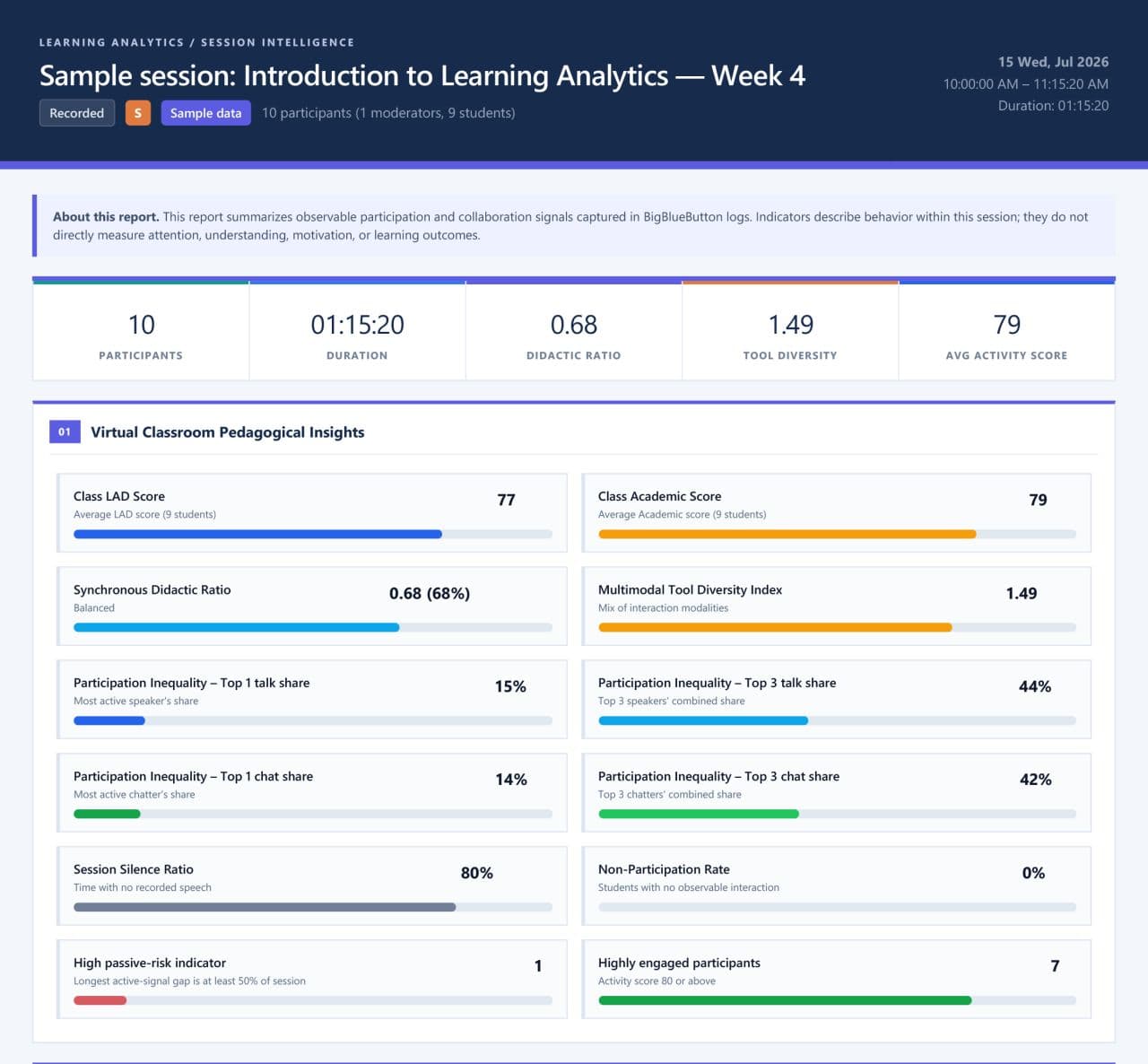
The blended learning research is clear that the online part must add something. After each session, link the recording in the course, follow up with a quiz or an assignment, and use the gradebook where the session counts. Then look at who took part: BigBlueButton's Learning Dashboard shows attendance and activity per student, and RIADVICE's Learning Analytics report for BigBlueButton turns a session into pedagogical indicators that a teacher can act on.
What the research does not say
The evidence has limits, and they are worth knowing before making decisions with it.
Most effects are small to moderate. Many studies are small, and the strongest results come from courses that also added time, resources and interaction, so the medium alone cannot take the credit. Live online teaching matches the classroom; it does not reliably beat it. And very few controlled studies have measured BigBlueButton inside Moodle specifically: the research is about live online and blended learning in general, which is what these two tools deliver.
None of that weakens the main finding. It moves the credit to where it belongs: to the design of the course, which good tools make easier and poor ones make harder.
Moodle and BigBlueButton at scale
For institutions, the practical question is how to run the two reliably for thousands of students, at the same hour, every week.
That is the work RIADVICE does. We provide BigBlueButton hosting that plugs into Moodle, and we develop ZcaleRight, the load balancer that spreads classes across a cluster of BigBlueButton servers. At Biruni University in Istanbul, it runs BigBlueButton for Moodle across more than 12,000 students. Our BigBlueButton Analytics then shows what happened in every class.
If you are planning live online classes in Moodle, or want the ones you run to work better, talk to our team.